
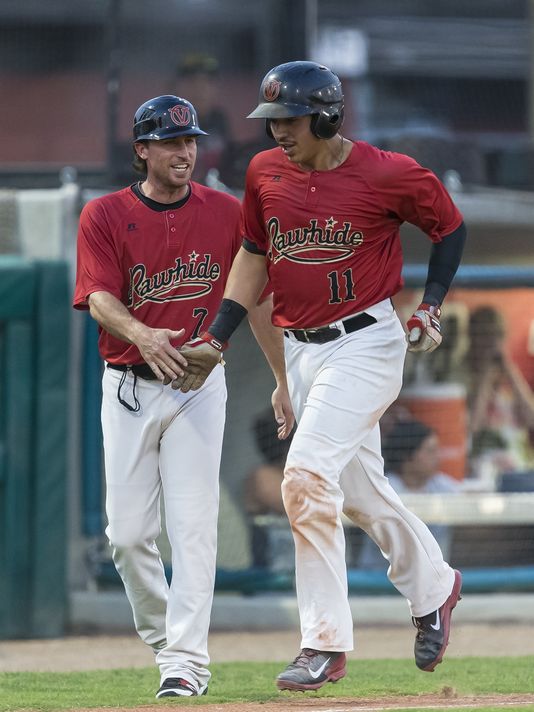
 Now that Rudy Flores (Haymarket 2010) is hitting an even .300, the time has come to take a look at his curious statistical profile.
First of all, when Rudy played in the Valley, he was clearly one of the best players in the league. He didn’t get enough at-bats to qualify for the batting title (and subsequently my top hitters list), but the at-bats he did get were nothing but impressive. Baseball America named him the 5th best prospect in the league after the season. I remember seeing him crush a fastball at Harrisonburg- the ball was gone in what seemed like a second and a half.
Rudy was drafted out of Florida International in the 21st round in 2012 by the Arizona Diamondbacks. They assigned him to the rookie level Arizona League, where Flores got only 10 at-bats, before moving to the Pioneer League, which was much closer to his ability (and age). Combined over the two levels, Flores hit 302/388/430 in 49 games and 179 at-bats, with 12 doubles and 3 home runs. His numbers were strong across the board, besides one curious thing: he struck out 52 times in those 179 at-bats, while walking only 22 times. The strikeout rate of 29% was high, but he still produced, obviously, with his other rate stats.
In 2013, Rudy was assigned to South Bend in the Midwest League. In 92 games and 343 at-bats, he hit 274/337/528, with 24 doubles, 3 triples, and 19 home runs. The good news is that his slugging percentage spiked almost 100 points from his first season. The bad news? Well, he struck out 134 times against 31 walks. So while his power went up, so did his strikeout rate- to 39%.
So now, 2014. Flores was assigned to Visalia, in the California League. The Cal League is well known as a hitter’s paradise, so I was hoping for a breakout for young Rudy. Let’s see what has happened so far:
In April, Rudy got off to a bit of a slow start, hitting 260/321/460 in exactly 100 at-bats. He hit 5 doubles and 5 home runs. Ah, but what about that other, curious stat? Rudy struck out 40 times, while getting a free pass only 5 times. (That’s a strikeout rate of 40%.)
May? Rudy dropped a bit from April, hitting 211/263/321 in 109 at-bats, with 3 doubles, 3 home runs, and a 6/37 BB/K ratio. His K rate went “down” to 34%, but his rate stats bottomed out. At this point, I was wondering if the breakout would come.
And then came June. Rudy’s batting average went way, way up, along with his other rate stats- he hit 333/367/589 in 90 at-bats. He hit 14 doubles, 3 home runs, and his BB/K ratio was 4/33. (37% K rate) So, it can’t get much better than this, right? Hang on—
July. 381/434/703 in 28 games and 118 at-bats. That incredible slugging percentage came from 8 doubles and 10 home runs. What about that BB/K ratio? It was 10/41, which comes to a 35% K rate. He improved for the second month is a row.
In August so far, Rudy is 4-10 after 3 games, with 2 more home runs, and 3 more strikeouts.
Deep breath. Let’s put it all together, shall we? For the season thus far, Rudy is hitting 300/350/532 in 107 games and 427 at-bats. He has 30 doubles, 23 home runs, and a 25/154 BB/K ratio (36% K rate). He is already tied for the 5th most home runs in a minor league season (since 2006), and still has almost a month to go.
Conventional wisdom would say that Rudy really needs to cut down on his strikeouts to be a successful hitter at higher levels in the minors, and that we should be careful making broad assumptions based on one season in the Cal League. But, as my more positive side would attest, it’s surely better to hit well than poorly, right? Joey Gallo cut down on his strikeouts, so why can’t Rudy?
At any rate, ATVL will be following Rudy’s career to the end…
 All Things Valley League